

This Rafter Length Calculator helps you find common rafter length from roof span, horizontal run, rise, pitch, roof angle, and optional overhang. It works with imperial or metric units and also shows useful roof geometry such as rise, angle, pitch multiplier, and estimated rafter count.
Main inputs
For a gable roof, span is the full outside wall to outside wall width.
Enter the full roof span before the ridge adjustment.
For example, enter 6 for a 6/12 pitch.
Optional details
Used only with gable roof span mode. Use 0 if unknown.
Use 0 if the rafter should stop at the wall line.
Used only to estimate rafter count and total board length.
Common rafter length
0
This is the sloped rafter length based on your inputs.


How to Use the Rafter Length Calculator
Choose your measurement system first, then select the roof type. For a gable roof, use Building span and pitch when you know the full outside wall to outside wall width. For a shed or lean-to roof, enter the one-slope horizontal run.
Next, enter the pitch, rise, or angle based on the mode you selected. Add ridge thickness only when using gable roof span mode. Add overhang if you want the result to include the rafter tail, then click Calculate.
What the Calculator Measures
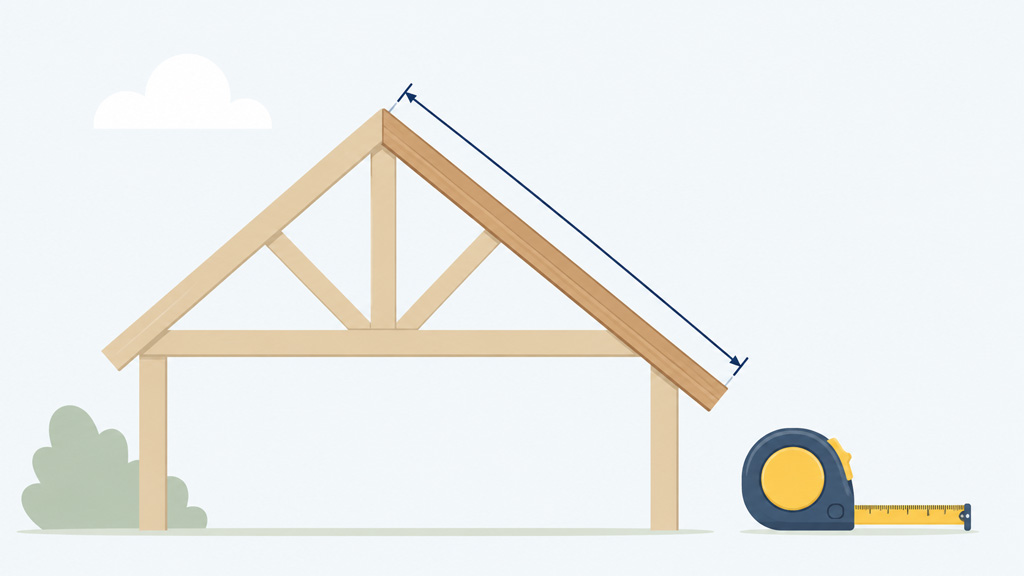
Span is the full width across a gable roof. Run is the horizontal distance covered by one rafter. Rise is the vertical height from the wall line to the ridge or upper bearing point. Pitch is the roof rise over 12 units of horizontal run, such as 4/12, 6/12, or 8/12.
The main result is the common rafter length, which is the sloped distance along the rafter. When overhang is entered, the calculator adds the sloped tail length to the rafter length.
Rafter Length Formula
The calculator uses right-triangle geometry. The horizontal run and rise are the two square sides of the triangle. The rafter is the sloped side.
- Pitch ratio = pitch rise ÷ 12
- Rise = run × pitch ratio
- Rafter length to wall line = √(run² + rise²)
- Pitch multiplier = √(1 + pitch ratio²)
- Sloped overhang = horizontal overhang × pitch multiplier
- Total rafter length = rafter length to wall line + sloped overhang
For a gable roof with a ridge board, the calculator can shorten the run to the face of the ridge:
Adjusted run = (building span – ridge thickness) ÷ 2
Example Rafter Length Calculation
For a 24 ft wide gable roof with a 6/12 pitch, the basic run is about 12 ft before any ridge adjustment. A 6/12 pitch means the roof rises 6 inches for every 12 inches of horizontal run, so the pitch ratio is 0.5.
If you enter a 1.5 in ridge thickness, the calculator subtracts that thickness from the total span before dividing by two. If you also enter a 12 in horizontal overhang, the calculator converts that overhang into a sloped tail length before adding it to the final rafter length.
Common Roof Pitch Reference
| Pitch | Angle | Slope Percent | Pitch Multiplier |
|---|---|---|---|
| 2/12 | 9.46° | 16.7% | 1.014 |
| 4/12 | 18.43° | 33.3% | 1.054 |
| 6/12 | 26.57° | 50.0% | 1.118 |
| 8/12 | 33.69° | 66.7% | 1.202 |
| 12/12 | 45.00° | 100.0% | 1.414 |
What the Results Mean
Common rafter length is the main sloped length based on your inputs. Length to wall line is the rafter length before overhang. Sloped overhang added shows how much tail length was included.
Horizontal run used is the final run used in the math, including any ridge adjustment. Roof angle from horizontal helps describe the steepness. Pitch multiplier lets you quickly convert horizontal run into sloped length.
If roof length and rafter spacing are entered, the rafter count and total board length are planning estimates. Actual framing may need extra members at gable ends, openings, lookouts, blocking, hips, valleys, or other details.
Practical Framing Notes
- Measure span and run horizontally, not along the roof slope.
- Use building span only when the tool asks for span. Use one-side horizontal run when the tool asks for run.
- Decide whether your overhang is a horizontal projection or the sloped tail length before entering it.
- For a gable roof with a ridge board, ridge thickness slightly shortens each common rafter.
- Use the calculator result for planning and layout, then verify cuts on actual stock before cutting the full batch.
Roof Pitch and Roofing Material Limits
Rafter length and roofing material approval are separate issues. A low-slope roof may calculate correctly but still require special roofing details.
For asphalt shingles, the International Residential Code states that shingles are used only on roof slopes of 2:12 or greater. Slopes from 2:12 up to 4:12 require special underlayment details. Always check the code version adopted in your area and the roofing manufacturer’s instructions.
What This Calculator Does Not Do
This calculator gives rafter geometry, not structural rafter sizing. It does not check lumber species, grade, snow load, wind load, live load, dead load, deflection, bearing, fastening, or local building code requirements.
For structural design, use approved span tables, manufacturer data, local code requirements, or a qualified professional. The rafter length can be correct while the rafter size is still not adequate for the building.
Sources
- InterNACHI: Measuring Roof Slope and Pitch was used for the standard explanation of roof slope as rise over 12 inches of horizontal run.
- ICC Digital Codes: IRC R905.2.2 Slope was used for the asphalt shingle low-slope caution.
- American Wood Council: Span Options Calculator for Wood Joists and Rafters was used to separate geometric rafter length from structural rafter span and sizing.
CalcuLife.com






Leave A Comment