

The Corsi Block Memory Test (also called the Corsi Block-Tapping Test or CBTT) is a classic neuropsychological task used worldwide to measure visuospatial short-term memory and working memory capacity. In plain language: it checks how well you can watch a pattern and then immediately reproduce that pattern in the correct order using spatial position only (no words, no math, no language skills). The longest pattern length you can copy back with 100% accuracy is called your Corsi span, and this span is commonly used as an indicator of healthy visuospatial memory performance in research, clinical assessment, aging studies, attention/cognitive load studies, and fatigue studies.
Corsi Block Memory Test
This test measures your visual short-term memory. You will see blocks flash in a pattern. Your job: tap the blocks back in the same order.
How it works:
1. Pattern plays: blocks flash in order.
2. Your turn: tap the blocks in that same order.
3. If you’re correct, next round gets longer.
We’re testing classic forward Corsi span (same order).
Settings
Your Results
How to read it: A lot of healthy adults remember patterns of about 5–6 blocks in correct order. Being lower than that once does not mean anything medical. Sleep, focus, stress, and practice all change this score. This tool is for self-check only, not diagnosis.


How to Use This Test
This online version follows the core “forward Corsi” logic: the tool shows you a sequence of highlighted blocks (the pattern), and then you tap those blocks back in the exact same order. Each time you succeed, the sequence gets longer and harder. When you can’t reliably reproduce it anymore, the test ends and you get your best span. That “best span” is the main score people track.
- Press “Start New Test”. The tool generates a pattern and begins Round 1. You’ll see blocks flash in a specific order. During this time, just watch. Don’t tap yet.
- Wait for “Your turn”. After the flashing stops, the tool will clearly say it’s your turn. Now you must tap the blocks in the exact same order they flashed.
- Finish the whole pattern. Keep tapping blocks until you’ve entered the full sequence. You’ll see live counters like “3/5 taps done” so you know how far you are.
- Get immediate feedback. If you got the order right, the tool tells you you’re correct and automatically moves you to a longer pattern. If you missed, it tells you you’re wrong and (if you still have retries left for that difficulty) it will replay a new sequence of the same length so you can attempt that level again.
- Keep going until it ends. When you either run out of retries for a given pattern length or you can’t keep up with the sequence anymore, the test ends. The test will show an in-board overlay with a clear “Test finished” message and your best span so far.
- Read your results box. Under “Your Results”, you’ll see:
- Your best memory span – longest sequence you successfully reproduced with zero mistakes.
- Correct rounds total – how many rounds you nailed perfectly.
- Total mistakes – how many tap-order mismatches were detected overall.
- Status – whether you’re still in an active run or you are done.
- Press “Start New Test” again to retake. That resets logic and starts fresh with the starting length you picked in Settings.
What Makes This Test Legitimate
The Corsi task isn’t some random memory game someone made up yesterday. It’s a direct digital adaptation of a lab test introduced by psychologist Philip Michael Corsi in the 1970s as a nonverbal memory span test. It has been used for decades in cognitive neuroscience, neuropsychology, and clinical assessment. It is considered a standard tool for checking visuospatial short-term memory capacity and, in some versions, working memory. The version you’re using here reproduces three core elements that matter:
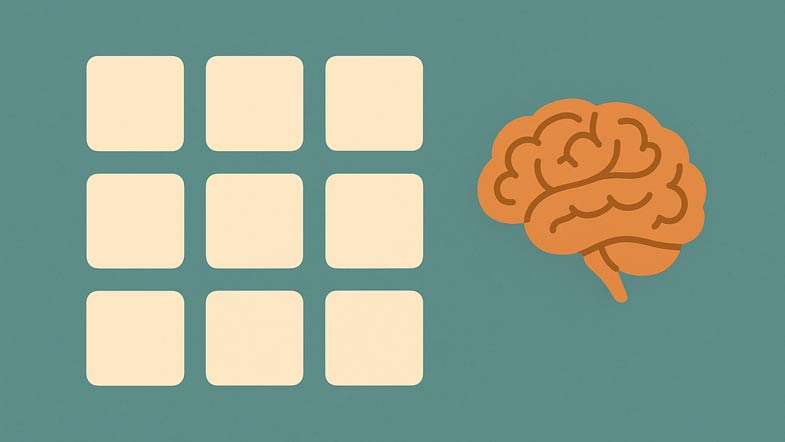
- Irregular block layout. The nine blocks are placed in a non-grid, non-symmetric arrangement. This mirrors the classic board, where blocks are physically glued in fixed but irregular positions. That layout forces you to memorize spatial locations, not just “top-left, top-right in a clean grid.”
- Forward recall in order. The standard “forward Corsi” rule is: you must tap the blocks in the same order they flashed. No reversing, no guessing set membership, no approximate recall. You either recreated the sequence or you didn’t. That simplicity is part of why this task is so widely studied.
- Increasing load. After every correct round, the tool adds one more block to the pattern. Memory load ramps naturally. This is how span is measured: you keep going until you hit the ceiling of what you can still track perfectly.
Because the rule set here (fixed board, forward sequence, increasing length) matches the core published structure of the original test, the score you get – your highest perfect length – is meaningfully comparable to what is reported in research as “Corsi span.”
You can read more background on the Corsi Block-Tapping Test here: Corsi Block-Tapping Test (Wikipedia reference).
Why People Care About Corsi Span
Human memory is not one single thing. Verbal memory (remembering a phone number someone said out loud) is not the same as visuospatial memory (remembering where things are in space). The Corsi test zooms in on that second system. A lot of labs use Corsi span to:
- Study attention and fatigue: If your span is usually 6 and today it’s 3, you might just be tired, distracted, or overloaded.
- Compare groups: It’s useful for comparing different age groups, because visuospatial memory can change across development and aging.
- Screen cognitive impact: It’s often used in clinical settings as part of a full neuropsych battery to look at memory, attention, and certain types of brain injury or impairment. (This online version is not a medical exam. It’s just the logic of the task.)
Why This Online Version Gives Clear Feedback
The interface is built to act like a real human tester sitting next to you and telling you what’s happening:
- “Watch the pattern” state: While blocks are flashing, you’re locked out from tapping. You can’t accidentally input early.
- “Your turn” state: After playback, the test switches to input mode. You can now tap blocks. Each tap gives instant visual feedback (a quick blink) so you know your tap registered.
- Live counters: You always see how many taps you’ve entered out of how many total in that round. You don’t have to guess if you’re done.
- Round result: After you finish tapping, the tool immediately tells you if you matched the full pattern (“✔ Correct sequence” vs “✘ That wasn’t the same order”).
- Automatic difficulty control: You never have to manually “go to next level.” If you’re correct, the tool just makes the next sequence longer. If you fail, it handles retries. If you’re fully done, it clearly says “Test finished,” locks the board, and overlays your best score inside the board so it’s impossible to miss.
This matters because confusion ruins memory testing. The user shouldn’t be wondering, “Am I supposed to tap now?” The UI tells you exactly what to do at each step.
Short History of the Corsi Block-Tapping Test
The test goes back to the early 1970s, when Philip Michael Corsi designed a physical board with nine identical wooden blocks glued in a non-regular pattern. The examiner tapped a sequence of blocks with a finger. The participant watched, then immediately tried to tap the same blocks back in the same order. The longest correctly repeated sequence length became that person’s span. The point of designing it this way was: no math, no reading, no spoken language needed. You can give it to children, adults, people who don’t share a language, or patients who have trouble with speech, because it’s all spatial and visual.
Over time, researchers added variants:
- Backward Corsi: Participant repeats the sequence in reverse order. This version stresses working memory manipulation more, not just storage.
- Computerized / tablet versions: Instead of a human tapping wooden blocks, the screen highlights them in order. That’s what you’re seeing here. The logic is faithful to the original method, but presentation and scoring are automated.
Even now, you’ll see Corsi Block tasks in academic papers, clinical neuropsychological test batteries, and cognitive training research. It’s one of the standard ways to talk about visuospatial span.
FAQ
1. What is a “span” in this test?
“Span” = the longest sequence length you reproduced with zero mistakes. If you successfully follow a 5-block pattern but fail every 6-block attempt, your span is 5.
2. Is a higher span always “better brain”?
Higher span usually means stronger visuospatial short-term memory in that moment. But it’s not an IQ score, not a diagnosis, and not a life label. Being tired, anxious, distracted, hungover, or hungry can tank your performance on a single run.
3. How often can I retake it?
You can retake immediately. In research settings, multiple trials are normal because span is only stable if you see a consistent range across attempts. If you do one run and get 4, then repeat and get 6, your “true” span is probably closer to the higher consistent number, not the tired/slow run.
4. Why does the board look kind of uneven / non-grid?
That’s intentional. The classic board uses nine blocks in a weird-looking layout. That forces you to remember actual spatial locations, not just “top row / middle row / bottom row in a perfect grid.” That makes the task more realistic and sensitive.
5. Why does the sequence get longer when I’m correct?
That’s how we find your ceiling. If you keep succeeding, you haven’t hit your limit yet. The only way to measure your max capacity is to keep increasing demand until you finally can’t keep it in working memory perfectly.
6. The test told me “Test finished.” Does that mean I failed?
No. “Finished” just means you reached your current limit under the chosen difficulty rules (speed of flashes, allowed retries, starting length). The overlay inside the board shows your best span and locks the blocks so you don’t keep tapping by accident. You can hit “Start New Test” and try again instantly.
7. Can this diagnose ADHD, dementia, or concussion?
No. This is not a medical diagnostic tool. The real Corsi task is often included in full neuropsychological assessments, but clinicians interpret it alongside many other tests, background, interview, and history. This widget is a practice / self-monitoring / curiosity tool. If you’re worried about memory changes, you should talk to a qualified clinician.
CalcuLife.com









Leave A Comment