

The Autism Spectrum Quotient (AQ) Test Online helps adults explore autistic traits across social interaction, communication style, attention patterns, flexibility, and imagination. It is based on the AQ framework, a 50-item adult self-report measure developed to study autistic traits, but it cannot diagnose autism by itself. Use your score and subscale pattern as a starting point for self-understanding or for deciding whether a professional autism evaluation may be useful.
Autism Spectrum Quotient (AQ) Test Online
Answer 50 questions about social communication, routines, attention, sensory-style preferences, and thinking patterns.
This tool is based on the structure and scoring logic of the Autism Spectrum Quotient, a 50-item adult self-report measure of autistic traits. It is not a diagnosis. Your result can help you understand your trait pattern and decide whether a professional autism evaluation may be useful.


What is the Autism Spectrum Quotient?
The Autism Spectrum Quotient, often called the AQ test, is a self-report screening measure created to estimate autistic traits in adults. It is commonly used in research and as a starting point for reflection, but it is not a medical diagnosis.
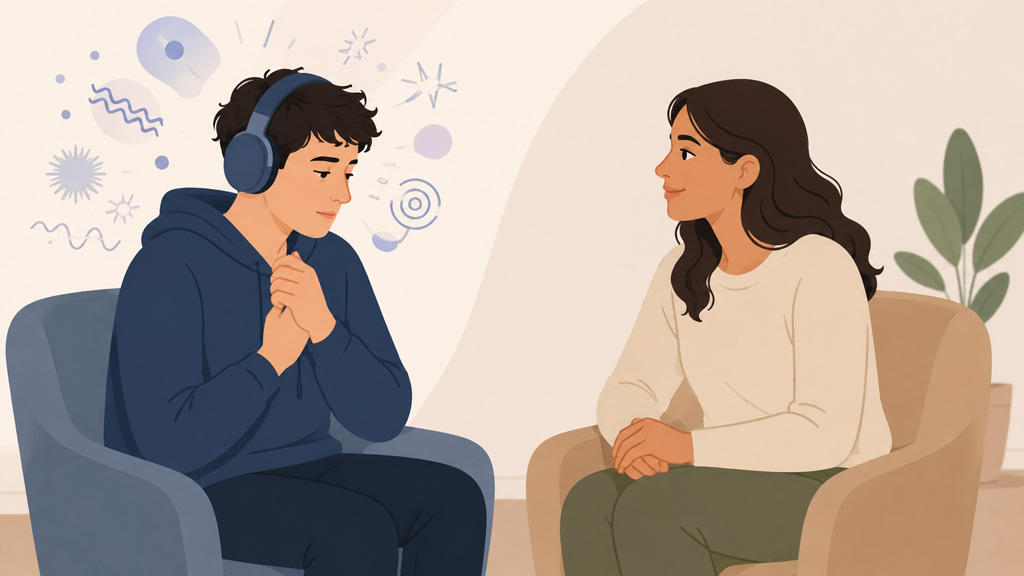
The AQ can be helpful because it separates different trait areas instead of giving only one number. For example, two people may get the same total score but have very different patterns: one may score higher in social communication, while another may score higher in routines, attention switching, or detail-focused thinking.
How AQ scoring works
The AQ uses a total score from 0 to 50. Higher scores usually mean more answers associated with autistic traits. The score should be read carefully because there is no single number that proves whether someone is autistic.
| AQ score | General interpretation |
|---|---|
| 0 to 19 | Lower range of autistic traits |
| 20 to 25 | Mild to moderate autistic-trait range |
| 26 to 31 | Elevated autistic-trait range |
| 32 to 50 | High autistic-trait range |
What a higher AQ score means
A higher AQ score means your answers match more traits commonly associated with autism. This may include social effort, sensory sensitivity, strong routines, difficulty with sudden changes, literal communication style, deep interests, or differences in how you read social situations.
A high score does not prove autism. It is best understood as a reason to look more closely at your real-life pattern, especially if these traits have been present for a long time and affect work, school, relationships, routines, sensory comfort, or communication.
What a lower AQ score means
A lower AQ score does not automatically rule out autism. Some adults mask or camouflage traits, interpret questions differently, or have experiences that are not fully captured by the AQ. If you still struggle with sensory overload, social exhaustion, shutdowns, routines, communication, or burnout, your experience is still worth taking seriously.
Why subscale results matter
The subscale breakdown can be more useful than the total score alone. A person may have a high detail-focused score but a lower social score, or a high communication-style score with moderate attention-switching difficulty. Looking at the strongest areas can help you understand what kind of support or evaluation might be most relevant.
- Social interaction: May point to effort, confusion, or fatigue in social situations.
- Attention switching: May point to difficulty with interruptions, transitions, or sudden changes.
- Attention to detail: May point to strong pattern recognition or noticing details others miss.
- Communication style: May point to preference for direct language or difficulty with hints and vague expectations.
- Imagination and perspective-taking: May point to differences in flexible imagining or predicting what others expect.
When to consider a professional autism evaluation
Consider a professional evaluation if your score is elevated or high and the traits affect daily life. Evaluation may also be useful if you have a long-term history of social confusion, sensory overload, intense interests, strong need for routine, shutdowns, meltdowns, masking, or repeated burnout.
A good autism assessment usually looks at more than a questionnaire. It may include developmental history, current functioning, social communication, restricted or repetitive patterns, sensory differences, mental health, ADHD, anxiety, trauma, sleep, and how daily life is affected.
What else can look like autism?
Some autism-like experiences can overlap with ADHD, anxiety, depression, trauma, social anxiety, obsessive-compulsive traits, giftedness, language differences, sensory processing differences, sleep problems, or chronic burnout. This is why a screening result should not be treated as a diagnosis by itself.
What to bring to an autism evaluation
- Examples of social misunderstandings, exhaustion after interaction, or difficulty reading expectations
- Examples of sensory sensitivity to sound, light, touch, smell, clothing, food texture, or crowds
- Examples of strong routines, distress from change, shutdowns, meltdowns, or burnout
- Notes about intense interests, repetitive habits, or preferred ways of communicating
- Childhood examples, school history, family observations, or old report cards if available
- Information about ADHD, anxiety, depression, trauma, sleep, medication, and daily-life impairment
Sources
Our test is based on the following:
CalcuLife.com









Leave A Comment