

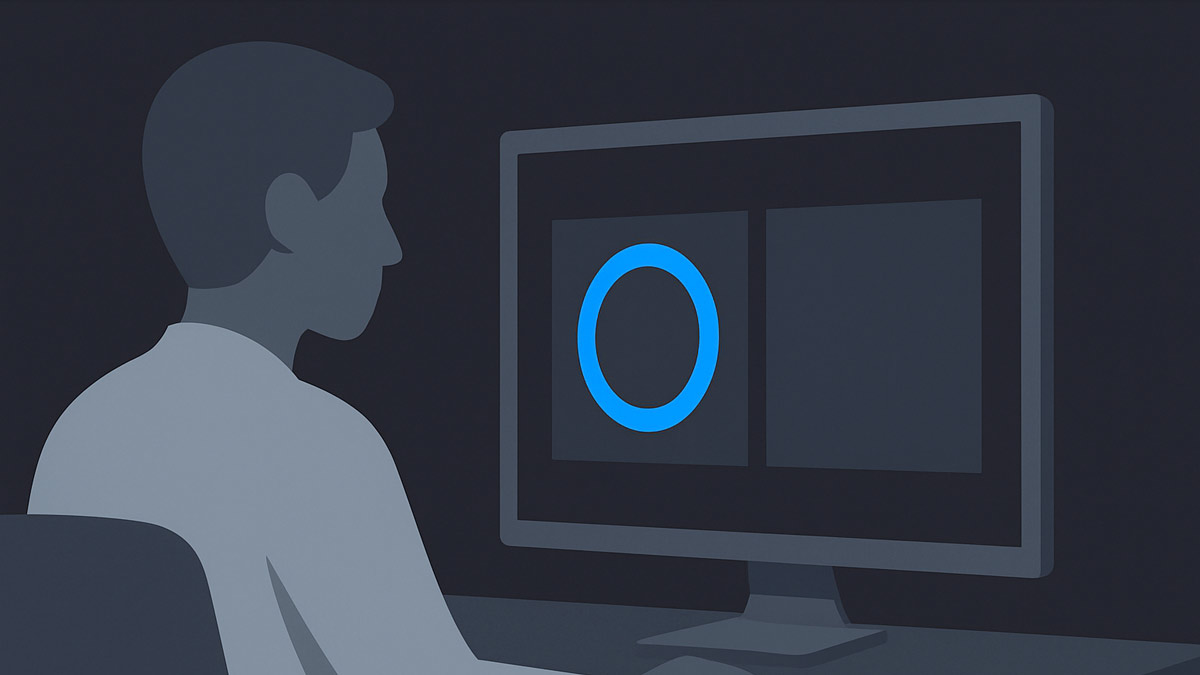
In this free color-blind test you’ll see two black panels on each trial. One side briefly shows a faint blue ring; the other stays plain black. Choose the side with the ring using the on-screen buttons or ← / → keys. The color of the ring adapts to your vision and answers. In the end of the test, You’ll see comprehensive results.


Quick Instructions
What you’ll see and how to answer
- Practice first, then begin the main test. You can also skip the practice.
- Each trial starts with a blank screen for ~0.5 s; then the ring appears and the timer starts.
- Pick the side that contains the ring. There’s always exactly one correct side.
Recommended display and lighting
- Turn off Night Shift / blue-light filters and similar “warm” display modes; they reduce blue output and can alter results. See Apple’s documentation on Night Shift and warmer color temperature. Apple Support; Mac Help.
- View at arm’s length in moderate ambient light; avoid glare.
- Keep the browser tab at 100% zoom.
What This Test Screens (Blue-on-Black, Tritan Axis)
This tool is a quick, device-dependent screening of blue-on-black discrimination that broadly relates to the blue-yellow (tritan) axis of color vision. Blue-yellow deficiencies (tritanomaly/tritanopia) are less common than red-green and affect discrimination of certain blue/green and yellow/red combinations. NEI: Types of Color Vision Deficiency. For general background on color vision deficiency, see NEI overview.
How It Works
Two-Alternative Forced Choice (2AFC)
You see two alternatives simultaneously and must choose one. 2AFC reduces response bias compared with yes/no tasks and is widely used in psychophysics. See introductions to 2AFC and related methodology: 2AFC overview; Levitt (1971) transformed up-down methods (PDF).
Adaptive difficulty and reaction-time handling
- Lead-in trial: The first test trial shows a slightly more visible ring so users notice the task has begun.
- Adaptive staircase: A 3-down/1-up rule tightens or loosens visibility to seek a stable threshold near ~79% correct, per classic transformed up-down procedures. Levitt (1971).
- Timing: Reaction time is measured only while the ring is visible; each trial includes a brief blank interval before the next one.
Understanding Your Results
Threshold scale and summary
Your main score is a blue-channel threshold (0–255). Lower numbers mean you could detect a fainter blue ring (greater sensitivity). The results panel also shows accuracy (%) and median reaction time (ms). Lead-in trials are excluded from those summaries to avoid inflation.
Ranges you may see
- Exceptional sensitivity: ~0–10
- Very high sensitivity: ~11–20
- High / upper-typical: ~21–50
- Typical range: ~51–60
- Lower-typical / below typical: ~61–90
- Reduced / markedly reduced: ~91–130
- Severely reduced: >130
These bands are for this specific on-screen task and may vary with display and lighting. Clinical testing uses standardized instruments (e.g., HRR plates, Farnsworth D-15) to classify color vision deficiencies. See test examples: HRR instructions (PDF); Farnsworth D-15 overview.
Factors That Can Affect Results
Display modes, blue-light filters, brightness, distance
- Blue-light / Night modes: Warmer color temperatures “show more yellow and less blue,” reducing blue output and potentially raising thresholds. Apple Support.
- Brightness & glare: Very low or very high brightness and screen glare can make detection harder.
- Viewing geometry: Extreme viewing angles or distances change apparent contrast.
FAQs
How accurate is an online blue-black test?
It’s a screening. It uses validated psychophysics ideas (2AFC; adaptive staircases) but results depend on your device and environment. For diagnosis, use a clinical exam. See Watson & Pelli (1983) QUEST and Levitt (1971) for background on adaptive thresholds.
Can Night Shift or blue-light filters change the result?
Yes. Warmer modes reduce blue output; turn them off for testing. Apple Support: Night Shift.
Is this a diagnosis?
No. It’s a quick screening aligned to a blue-black discrimination task. For suspected color vision deficiency, consult an eye-care professional and consider standardized tests (e.g., HRR, D-15). NEI.
Which devices work best?
Modern, well-calibrated displays in neutral mode, viewed at arm’s length under moderate ambient light.
Can I improve results by repeating the test?
Repeating under consistent, optimal conditions can stabilize estimates, but large improvements across tries often reflect changed conditions, not altered color vision.
What is your result? Would You like to see any extra features in the test? Let us know in the comments below!
CalcuLife.com


Leave A Comment