

The Ishihara Blue-Green Color Blind Test is an online tool designed to check how well you can distinguish between blue and green shades. It presents 20 Ishihara-style plates with colored dots, where numbers appear if the colors can be separated. The test adapts in difficulty as you answer, becoming easier or harder based on your responses. At the end, you receive a score, difficulty breakdown, and response time summary.
Educational only — not a medical diagnosis. If results worry you, speak with an eye care professional.
Ishihara Blue-Green Color Blind Test
This test evaluates your ability to distinguish blue-green colors using Ishihara-style plates.
Test Instructions
- Look at the circle and identify the number formed by the colored dots
- Type the number you see in the input field and click Submit
- If you cannot see a number, you can click Skip
- The test adapts to your ability - it becomes harder with correct answers
- Complete all 20 plates for a comprehensive assessment
- Ensure proper lighting and disable any color-adjusting features on your screen
- The test will measure your response time for each plate
Test Results


Features
- 20 Plates: Each test run presents 20 Ishihara-style circles.
- Adaptive Difficulty: Correct answers increase difficulty, incorrect or skipped answers decrease it.
- Seven Difficulty Levels: From Very Easy to Extreme, adjusting color saturation and hue difference.
- Dynamic Plate Generation: Every plate is newly generated with random color distributions—no two runs are the same.
- Number Range: Plates contain random numbers between 1 and 99.
- Blue–Green Focus: Plates specifically test discrimination on the blue–green (tritan) axis.
- Micro-Dot Patterns: Plates are built from randomized dot grids, blocks, and embedded shapes for realism and extra challenge.
- Response Time Tracking: Records how long you take to answer each plate.
- Performance by Difficulty: Tracks correct/incorrect answers at each level.
- Extreme Mode: At the hardest level, difficulty keeps escalating with each correct answer.
- Score Display: Running tally of correct answers during the test.
- Progress Bar: Visual indicator of how many plates are completed.
- Feedback Messages: Instant “Correct” or “Incorrect” feedback after every plate.
- Skip Option: Lets you skip if you don’t see a number, instead of guessing.
- Difficulty Indicator: Label plus dots show your current difficulty level.
- Results Summary: Final score, accuracy, average response time, and mastery estimate.
- Interpretation Text: Automatic explanation of what your performance means (educational only).
- Per-Level Stats: Shows correct answers, attempts, and accuracy for all 7 difficulty levels.
- Restart Button: Instantly reset the test to take it again.
- Responsive Design: Works on desktop, tablet, and mobile screens.
- Accessibility Support: Keyboard controls, ARIA live updates for screen readers.
- Educational Disclaimer: Clear statement that the test is not diagnostic, for awareness only.
Results & What They Mean
After 20 plates you’ll see:
- Score — how many you answered correctly.
- Highest difficulty reached — how well you handled subtle blue-green differences.
- Average response time — faster isn’t always better, but it can hint at confidence.
How to read your result
- Many correct at higher levels usually suggests typical blue–green discrimination.
- Struggles at easy levels may suggest a color vision issue. Online tests aren’t diagnostic—please follow up with a clinician.
This tool can highlight potential difficulties but cannot diagnose color vision deficiencies.
How This Test Works
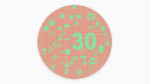
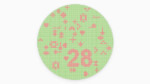
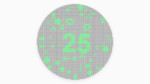
Ishihara plates hide a number inside a field of colored dots. People with typical color vision see the number, while others may not. This version focuses on the blue–green axis, adjusting color distance and saturation to change difficulty.
Limitations
- Screen quality, brightness, and ambient light can affect results.
- It checks performance patterns, not medical thresholds.
- If you wear color-correcting lenses or use display filters, results may not reflect your natural vision.
Calibration & Accessibility
- Disable color-altering modes (Night Shift, True Tone, blue-light filters).
- Use the same device for repeat tests to compare like-for-like.
- Keyboard: type the number and press Enter to submit. Use the Skip button if none is visible.
- Screen readers: progress updates are announced after each plate.
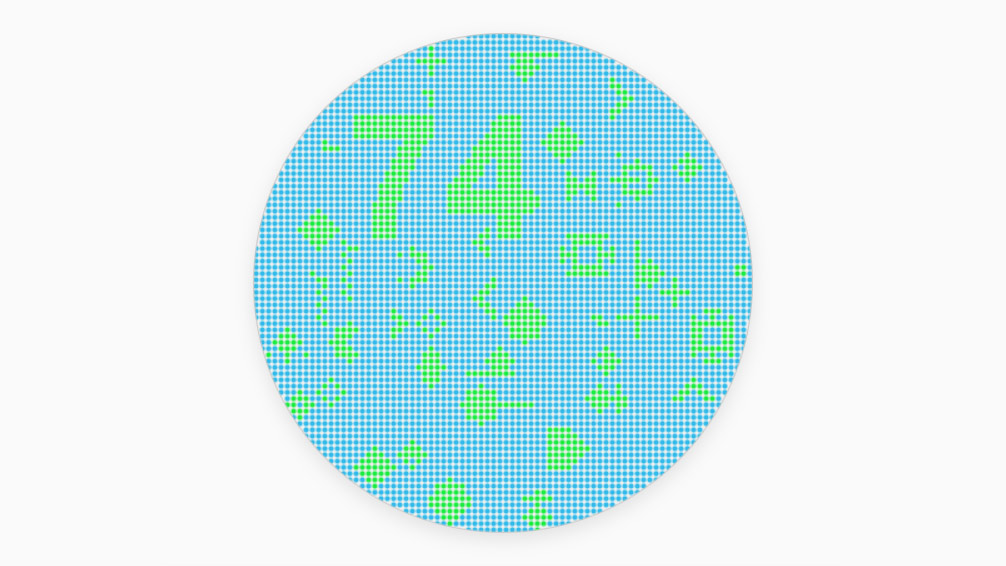
Number 74 on the plate, saturation of the colors is the same, the only difference is their hue.
Frequently Asked Questions
What does this test measure?
Your ability to tell apart blue and green hues in an Ishihara-style plate. It looks at patterns of correct/incorrect answers across difficulty levels.
Is this a medical diagnosis?
No. It’s a screening and learning tool. Only a qualified professional can diagnose color vision deficiency.
Why can I see some plates but not others?
Each plate changes color distance and saturation. As colors get closer together, it becomes harder to pick out the number.
Do phone displays work?
Yes, but larger, calibrated displays are more reliable. If you use a phone, turn off night mode and keep the screen steady.
Can I improve my score?
There’s no “training” for color vision, but stable lighting, a neutral screen profile, and no filters will give a fairer result.
Sources and References
What are your results in this test? Would you like to see any more features within the test? How do you like it? Share your thoughts in the comments section below!
CalcuLife.com




Leave A Comment