

Among the various types of color vision challenges, difficulty distinguishing blue from grey tones often goes unnoticed because it is less commonly tested. The Ishihara Blue-Grey Color Discrimination Test is designed to evaluate this specific ability by adapting the classic Ishihara plate method.
Ishihara Blue-Grey Color Discrimination Test
This test evaluates your ability to distinguish blue from desaturated (greyish) backgrounds using Ishihara-style adaptive plates.
Test Instructions
- Look at the circle and identify the number formed by the coloured dots
- Type the number you see in the input field and click Submit
- If you cannot see a number, you can click Skip
- The test adapts to your ability — it becomes harder with correct answers
- Complete all 20 plates for a comprehensive assessment
- Ensure proper lighting and disable any colour-enhancing or -adjusting features on your screen
- The test measures your response time for each plate
Test Results


How the Test Works
The tool presents you with 20 Ishihara-style plates. Each plate contains a number formed by colored dots against a greyish background.
- View the plate carefully.
- Type the number you see into the answer box.
- Click Submit to record your response.
- If no number is visible, click Skip.
The test adapts in real time: correct answers increase the difficulty, while incorrect or skipped plates reduce it. This ensures results are personalized and accurate.
What Is the Ishihara Blue-Grey Color Discrimination Test?
The Ishihara Blue-Grey Color Discrimination Test is an adaptive online screening tool that evaluates your ability to separate vivid blue hues from desaturated grey backgrounds. Unlike the traditional Ishihara test, which focuses on red-green deficiencies, this version is tailored to explore the blue-grey spectrum.
- Focus: Blue vs. neutral grey tones
- Method: Number plates made of colored dots
- Assessment: Accuracy, response time, and difficulty level progression
Why Blue-Grey Vision Matters
Although red-green color blindness is more common, blue-grey confusion can impact specific tasks, such as:
- Reading maps or charts with blue shading
- Interpreting clinical or scientific data visualizations
- Identifying safety signals in aviation or maritime environments
- Distinguishing denim, slate, or steel-grey fabrics in fashion and design
Testing this ability ensures a more complete picture of your color vision health.
What the Test Measures
The Ishihara Blue-Grey Color Discrimination Test provides a multi-layered assessment:
- Score out of 20: Total correct answers
- Accuracy percentage: Ratio of correct to total attempts
- Response time: How quickly you identify numbers
- Difficulty mastery: Highest level at which you can reliably discriminate blue from grey
- Estimated threshold: The smallest difference in hue (Δh) you can perceive
Difficulty Levels Explained
The Ishihara Blue-Grey Color Discrimination Test adjusts its difficulty dynamically as you progress. There are seven levels in total, each representing a finer challenge in separating blue tones from greyish backgrounds.
- Level 1: Very Easy – Strongly saturated blue dots against a flat grey background. The contrast is clear and easy to identify.
- Level 2: Easy – Blue remains vivid but with slightly less saturation.
- Level 3: Moderate – Blue and grey begin to overlap visually. Numbers are still readable, but the distinction is no longer immediate.
- Level 4: Medium – Saturation is reduced further, and hue differences shrink. Numbers may take longer to recognize.
- Level 5: Hard – Blue tones start blending with desaturated grey, creating subtle contrasts that challenge perception.
- Level 6: Very Hard – The separation between blue and grey becomes minimal. Only those with strong color discrimination can reliably see the numbers.
- Level 7: Extreme – The ultimate challenge. Blue dots are nearly indistinguishable from grey, approaching the threshold of human perception. Identifying numbers here demonstrates exceptionally fine blue-grey sensitivity.
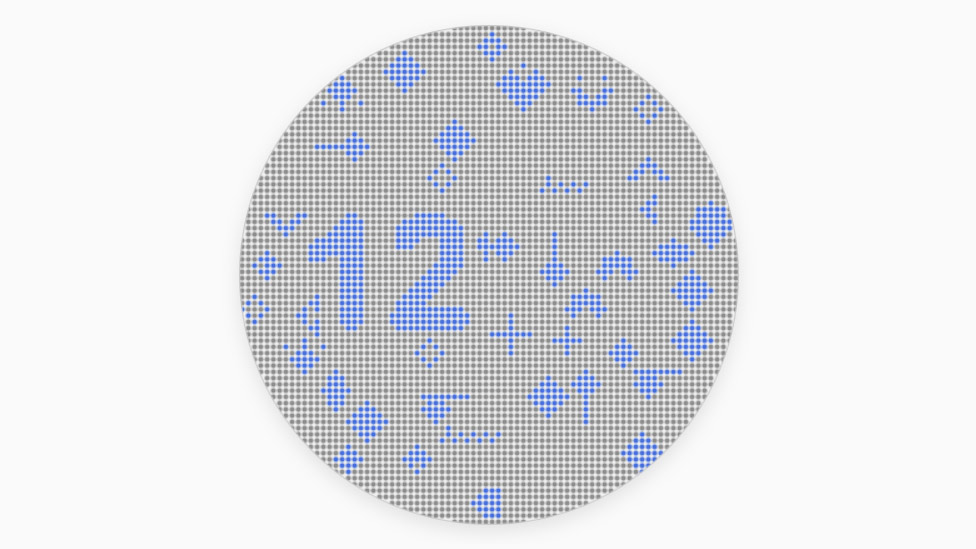
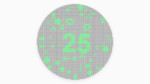
Blue-gray Ishihara plate from the easy level of our test.
Each level is designed to pinpoint your threshold of discrimination. The higher the level you can reach with accuracy, the greater your ability to perceive subtle differences in the blue-grey spectrum.
Interpreting Your Results
Your results may fall into one of the following categories:
- Excellent discrimination: You can distinguish even the smallest Δh (hue difference).
- Good discrimination: Slight difficulty, but well within normal range.
- Mild reduction: Occasional trouble with subtle contrasts.
- Moderate reduction: Noticeable challenges with blue-grey separation.
- Marked reduction: Strong difficulty; further clinical testing recommended.
Practical Applications
This test is useful for:
- Students & professionals: Ensuring accurate interpretation of visual data.
- Designers & artists: Checking perception of subtle color differences.
- Pilots & navigators: Screening for challenges in environments where blue-grey cues matter.
- Everyday users: Gaining awareness of personal vision strengths or weaknesses.
Limitations of the Test
While this tool is highly adaptive and informative, it is not a diagnostic test. Limitations include:
- Screen calibration and lighting conditions may affect results
- Fatigue and distractions can slow response times
- Clinical confirmation is required for medical use
How to Prepare Before Taking the Test
To get reliable results:
- Sit in a well-lit room with natural, neutral lighting
- Avoid tinted glasses, filters, or screen enhancements
- Use a calibrated device (phone, tablet, or monitor)
- Ensure you are well-rested and focused
FAQs
Q1: How long does the test take? A: On average, the test takes about 5-7 minutes to complete.
Q2: Can this test diagnose color blindness? A: No. It is a screening tool, not a diagnostic exam. For medical confirmation, consult an optometrist.
Q3: What does Δh mean in my results? A: Δh represents the hue difference. A smaller Δh means you can distinguish finer differences between blue and grey.
Q4: Can I repeat the test? A: Yes. In fact, repeating it under different lighting conditions is a good idea to rule out environment effect on the results.
Q5: Who should take this test? A: Anyone curious about their blue-grey discrimination ability, particularly professionals in design, aviation, navigation, or data visualization.
Q6: How accurate is this test? A: It is highly adaptive and precise for self-screening, but environmental factors affect accuracy.
Conclusion
The Ishihara Blue-Grey Color Discrimination Test is a modern adaptation of the traditional Ishihara plates, offering a unique look into your ability to tell vivid blue tones from neutral greys. While not diagnostic, it provides valuable insights into your visual perception, reaction speed, and adaptive ability.
✅ Tip: For more details on color vision and medical screening, see the American Academy of Ophthalmology.
If your results suggest reduced discrimination, consider repeating the test under neutral conditions or consult an eye care professional for a comprehensive evaluation.
What were your results? Would you like any more features to this test? Let us know in the comments!
CalcuLife.com



Hi,
There is a little bug in the way the test results are presented. In the “Scientific details” paragraph it shows the two “Most challenging correctly identified plates”, and the Δh for each. Then after that there is a line saying “Comparison: the two plates differ by…”. This line is wrong, it’s calculating the difference between the two Δh of the two most challenging plates. So for example if your two most challenging were both 2°, then that line will read “Comparison: the two plates differ by 0° in hue-difference” which is obviously wrong and has no meaning. It’s taking the difference of the differences.
Instead it should take the smallest of the two. Or just not write that comparison line.
This line could be very misleading because even someone with very poor discrimination could get a very low value here.
Hey Joan, thank you so much for taking the time to write the comment! I removed that misleading line.