

Online calculator for converting volumetric flow from cubic metres per day (m³/d; also m3/d, m^3/day, cmd) to litres per second (L/s; also l/s). Legitimacy: factors are exact under SI—1 L = 10−3 m³ and 1 day = 86 400 s—so results are reproducible and standard-compliant.
Cubic Meters per Day (m³/d) to Liters per Second (L/s) Converter
Enter a value in the field below and press the button
Flow in m³/d
Result in L/s


How to use
- Enter a flow value in m³/d in the input field.
- Click Convert to compute L/s.
- Set Decimal Places (0–10) to control rounding of the displayed result (calculation remains exact).
- Use Copy to put the result on your clipboard.
- Use Swap to open the reverse tool (L/s → m³/d).
- Click Clear to reset inputs, output, and the calculation line.
Definitions of measurement units
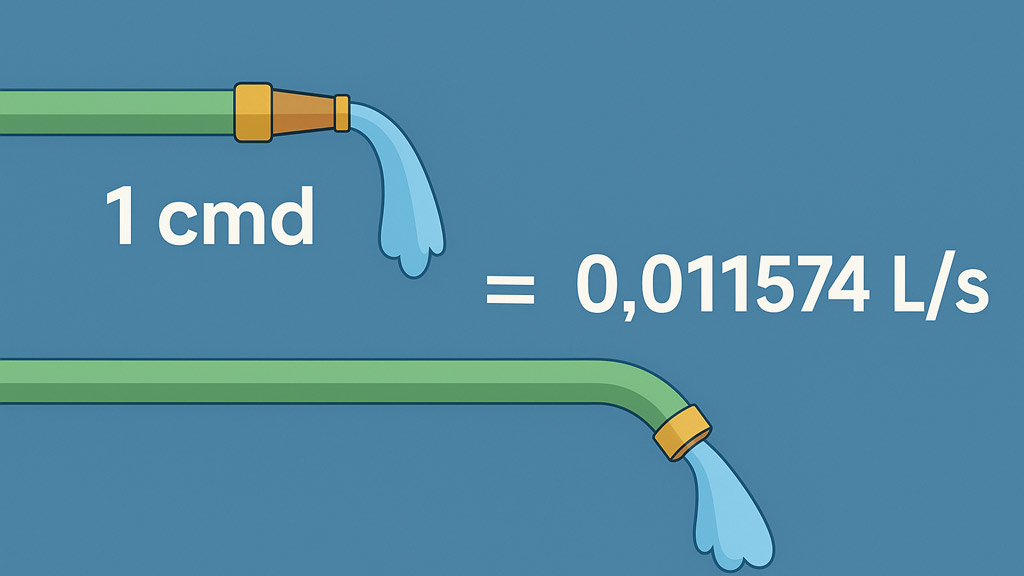
Cubic metre per day (m³/d) — a flow unit derived from the cubic metre (m³), the base SI unit of volume. It measures the volume of one cubic metre passing through a system in 24 hours. Abbreviations include m³/d, m3/d, m3/day, and cmd. System: SI (derived). Exact relation in this conversion: 1 m³/d = 0.011574 L/s. In another SI unit of time, 1 m³/d = 1000 litres per 86 400 seconds. Typical uses: water treatment plant capacity, municipal water supply planning, and industrial process outputs expressed per day.
Litre per second (L/s) — a unit of flow rate accepted for use with the SI, based on the litre (L), where 1 L = 0.001 m³. It indicates the number of litres moving each second. Abbreviations: L/s, l/s. System: SI-compatible. Exact relation in this conversion: 1 L/s = 86.4 m³/d. In relation to Imperial/US customary units, 1 L/s ≈ 15.8503 US gallons per minute (gpm). Typical uses: firefighting flow ratings, pump and pipe sizing, HVAC and irrigation design, and instantaneous hydraulic performance tests.
Conversion formula
L/s = (m³/d) × 1000 ÷ 86 400 = (m³/d) ÷ 86.4
m³/d = (L/s) × 86.4
Source: BIPM — The International System of Units (SI), 9th edition (exact definitions: litre as 10−3 m³ and day as 86 400 s).
Conversion table (m³/d → L/s)
| m³/d | L/s |
|---|---|
| 1 | 0.011574 |
| 5 | 0.057870 |
| 10 | 0.115741 |
| 20 | 0.231481 |
| 50 | 0.578704 |
| 75 | 0.868056 |
| 100 | 1.157407 |
| 150 | 1.736111 |
| 200 | 2.314815 |
| 250 | 2.893519 |
| 300 | 3.472222 |
| 500 | 5.787037 |
| 750 | 8.680556 |
| 1000 | 11.574074 |
| 1500 | 17.361111 |
| 2000 | 23.148148 |
| 3000 | 34.722222 |
| 5000 | 57.870370 |
| 10000 | 115.740741 |
| 20000 | 231.481481 |
Real-world, exact-rating examples
- Water meter (ISO 4064) Q3 2.5 m³/h: 60 m³/d = 0.69444 L/s
- Water meter (ISO 4064) Q3 4.0 m³/h: 96 m³/d = 1.11111 L/s
- Water meter (ISO 4064) Q3 6.3 m³/h: 151.2 m³/d = 1.75 L/s
- Water meter (ISO 4064) Q3 10 m³/h: 240 m³/d = 2.77778 L/s
- Water meter (ISO 4064) Q3 16 m³/h: 384 m³/d = 4.44444 L/s
- Fire pump (EN 1028) FPN 10-1000: 1 440 m³/d = 16.6667 L/s (1000 L/min)
- Fire pump (EN 1028) FPN 10-1500: 2 160 m³/d = 25.0 L/s (1500 L/min)
- Fire pump (EN 1028) FPN 10-2000: 2 880 m³/d = 33.3333 L/s (2000 L/min)
- Fire pump (EN 1028) FPN 10-3000: 4 320 m³/d = 50.0 L/s (3000 L/min)
- Large water meter (ISO 4064) Q3 25 m³/h: 600 m³/d = 6.94444 L/s
What’s your use case for this calculator, and what would you like added (e.g., batch conversion, unit mixing, copy as CSV)? Tell us in the comments.
CalcuLife.com








Leave A Comment