

Use this Arccos (inverse cosine) calculator to get the principal angle θ from a cosine value x. The math behind the tool follows the standard definition of the inverse circular functions as documented by NIST’s Digital Library of Mathematical Functions (see Inverse Circular Functions at dlmf.nist.gov/4.23).
Arccos Calculator (θ = arccos x)
Enter a cosine value x in the range −1 to 1, then press Calculate to get θ in degrees. You’ll also see radians and a unit-circle view.
Input x (−1 … 1)
Angle θ (degrees)


How the arccos calculator works
- You enter a number x between −1 and 1.
- The tool computes θ = arccos(x) as the principal value in radians, then shows degrees as well.
- It also displays sin(θ) and a clean unit-circle visualization of the radius, projections, and point.
Definition and formula
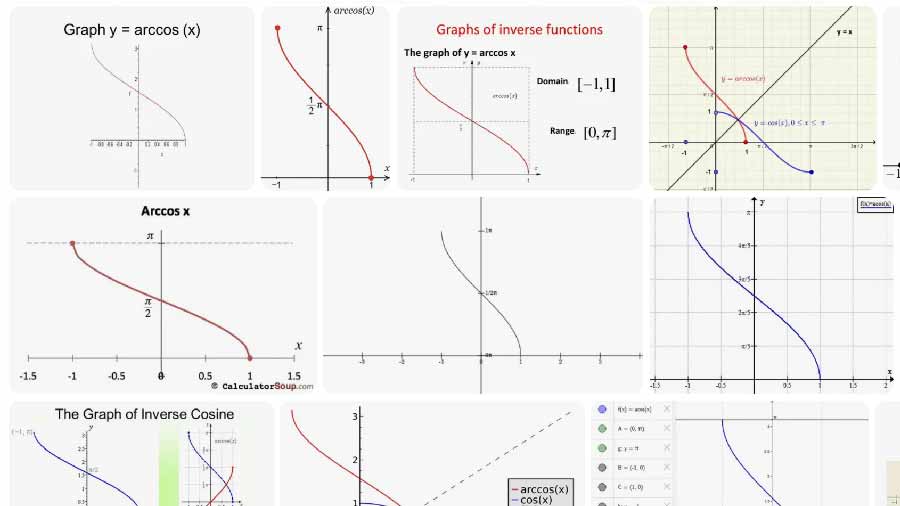
Arccos returns the principal angle θ that satisfies cos(θ) = x.
- Input domain: x ∈ [−1, 1]
- Output range (principal value): θ ∈ [0, π] radians, which is [0°, 180°]
- Conversion: degrees = radians × 180/π
Key identity: if cos(θ) = x, then θ = arccos(x). For angles outside the principal range, other solutions exist: 2π − θ, etc. This tool reports the principal value by design.
Inputs, outputs, and precision
- Valid input x: any real number from −1 to 1. Values outside this range are undefined for real angles.
- Angle formats: the tool shows both degrees and radians.
- Decimal places: use the “Decimal Places” control to set rounding (0–10). Radians often benefit from 4–6 decimals; degrees are commonly fine with 2–4.
Quick examples
- x = 1 → θ = 0 rad = 0°
- x = 0.5 → θ = arccos(0.5) = π/3 ≈ 1.0472 rad ≈ 60°
- x = 0 → θ = π/2 ≈ 1.5708 rad ≈ 90°
- x = −1 → θ = π ≈ 3.1416 rad = 180°
Unit-circle interpretation
On the unit circle (radius 1), x is the adjacent side of the right triangle built from the positive x-axis to the point on the circle, and √(1 − x²) is the opposite side. Arccos returns the angle θ that places the point at (x, √(1 − x²)) on the upper semicircle or (x, 0) at the endpoints. The canvas shows the radius to that point and dashed projections onto the axes.
Common uses of arccos
- Angle between vectors: with normalized vectors u and v, u·v = cos(θ) ⇒ θ = arccos(u·v).
- Geometry and triangles: recover an angle from side lengths via the Law of Cosines.
- Robotics and 3D graphics: convert dot products to angles for lighting, camera, and pose calculations.
- Signal processing: phase relationships and correlation angles.
Accuracy and rounding notes
- Floating-point input near ±1 can magnify rounding noise. If a value like 1.0000001 appears, clamp it to 1 for a stable result.
- Radians carry exact simple forms for special angles (π/3, π/2, π). The decimal display will show rounded approximations.
- If you need maximum precision, increase the decimal-places control and read the radian value.
FAQ
Is arccos the same as cos⁻¹?
Yes. cos⁻¹(x) means the inverse function arccos(x), not 1/cos(x).
Why does the calculator reject values smaller than −1 or greater than 1?
For real angles, cosine is bounded to [−1, 1]. Inputs outside that interval have no real arccos.
Why do I only get one angle?
The calculator returns the principal value in [0, π]. Other coterminal or supplementary angles exist, but the principal branch is standard for inverse trig functions and keeps results predictable.
Should I use degrees or radians?
Use degrees for day-to-day interpretation and radians for calculus, physics, and most programming libraries.
What is your case of using this calculator? Would you like any other tools or features? Let us know in the comments!
CalcuLife.com





Angle change this name