

Browser-based Stroop test that measures selective attention and interference control. You identify the ink color of color words while the tool times each response, classifies accuracy, and computes the Stroop effect (mismatch minus match reaction time). Runs locally in the page; no data leaves the browser. No e-mail or registration needed to get the results.


Features
- Practice then test: Infinite practice until you press the Stop button. Main test block of 40 trials.
- Stimuli: Words RED/GREEN/BLUE/YELLOW shown in red/green/blue/yellow ink; congruent vs incongruent are balanced and shuffled with run-length limiting.
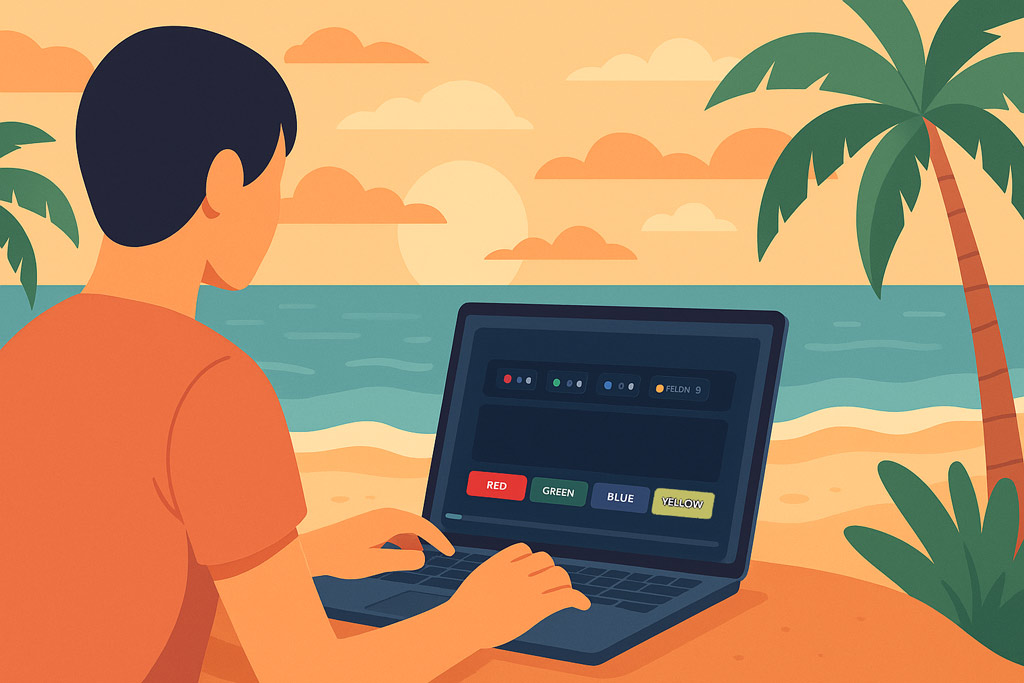
- Input: Keyboard keys 1=RED, 2=GREEN, 8=BLUE, 9=YELLOW, or on-screen color buttons.
- Timing: Inter-trial interval 500–1200 ms; per-trial timeout 2000 ms; responses <100 ms excluded as anticipated/accidential.
- Feedback: Correct/incorrect chip during practice; no feedback during the main test block.
- Progress + status: Live progress bar and trial counters.
- Results: Mean RT (match vs mismatch), accuracy (overall/match/mismatch), and Stroop effect in ms, with trimmed outliers (mean + 2.5 SD).
- Visuals: Vertical RT bars and donut charts for accuracies, plus concise interpretation text.
- Controls: Start practice, Start test, Stop; automatic 3-second countdowns before blocks and results.
- Attention safety: Trials cancel on tab hide to protect timing validity.
- Accessibility & UX: ARIA live regions, reduced-motion friendly animations, mobile-ready layout, and disabled focus on CTA to keep number keys active.
- Privacy: All computations run in your browser; no storage or upload to our end.
Reading your results
- Stroop effect (ms): Difference between mean mismatch and match RT. Smaller values indicate better interference control.
- Accuracy (%): Overall and per condition. Large gaps between match and mismatch accuracy point to conflict-driven slips.
- Speed–accuracy trade-off: Very low RTs with low accuracy suggest guessing; slower RTs with high accuracy suggest cautious control.
Why this Stroop test matters
This task probes selective attention, response inhibition, and conflict monitoring. Roles with safety or high consequence—e.g., rail operators, airside ground crew, control-room staff, emergency dispatch—often rely on fast, accurate color-coded decisions amid distraction. A simple, local Stroop run offers a quick look at how interference slows responses and where errors cluster.
Practical uses
- Pre-employment screening support: As one small component in multi-method assessments, it highlights interference cost and accuracy under conflict.
- Self-check before aptitude tests: Candidates see typical reaction-time ranges for match vs mismatch trials and can familiarize themselves with key-mapping tasks.
- Fatigue or workload monitoring: Repeated sessions (same setup, similar time of day) can reveal drift in accuracy or reaction times associated with sleep loss or shift work.
- Training programs: Attention and inhibition drills often track a reduced Stroop effect and fewer mismatch errors over time.
- Human-factors studies: Quick pilot data on interference cost before larger lab protocols.
Validity notes
- Standardize conditions: Same device, same keyboard, similar time of day, minimal background tasks improve comparability.
- Practice effects: Scores usually improve across the first sessions. Compare after familiarization.
- Device effects: Touch input is typically slower than a physical keyboard. High-latency displays can inflate RTs.
What’s your best result? Would you like to have any more features in this test? Let us know in the comments!
CalcuLife.com








Leave A Comment