

The yellow-blue color blind test, often referred to as a tritanopia test or tritanomaly test, is designed to evaluate how well a person can distinguish between blue and yellow hues. Tritan deficiencies, though rare, can still affect visual perception. This online color vision test is suitable for people who suspect vision problems, students in health sciences, or anyone curious about their color perception. It functions as a screening and educational tool, not a medical diagnosis, but provides structured results such as accuracy, timing, and level progression.
Ishihara-Style Blue–Yellow Vision Test Online
This adaptive screening evaluates your ability to distinguish blue from yellow hues using procedurally generated Ishihara-like plates that progressively tighten chromatic differences.
Test Instructions (Blue–Yellow)
- Look at the circle and identify the number formed by colored dots (blue vs yellow families)
- Type the number you see in the input field and click Submit
- If you cannot see a number, you can click Skip
- The test adapts to your ability - correct answers reduce the blue–yellow separation
- Complete all 20 plates for a robust estimation of your blue–yellow threshold
- Use neutral lighting and disable colour enhancing / night-mode / HDR adjustments
- The test measures your response time for each plate
Blue–Yellow Test Results


How to use the test
- Ensure your screen is free of color filters, blue-light reduction, or night mode.
- Sit at a comfortable distance from the display with neutral room lighting.
- Start the blue yellow color test and observe each plate carefully.
- Type the number you see into the answer field, or select Skip if nothing is visible.
- The system adapts in difficulty: correct responses increase challenge, while errors lower it.
- At the end, results show your score, highest level reached, and average response time.
- Interpretation: consistent success at higher levels suggests typical vision, while difficulty at easier levels may indicate possible tritan deficiency.
Features of the test
- 20 Ishihara-style plates per run, one canvas-rendered circle per plate.
- Input accepts integers 1-99, with Submit and Skip controls.
- Immediate feedback states Correct, Incorrect (shows true number), or Skipped.
- Per-plate response time is recorded and shown inline.
- Continuous difficulty variable mapped to seven labels: Very Easy, Easy, Moderate, Medium, Hard, Very Hard, Extreme.
- Correct answers raise difficulty; errors or skips lower it.
- Extreme mode adds micro-steps (up to 30) that subtly tighten colour separation and saturation; repeated correct answers keep escalating the difficulty.
- Procedural plates with short-wavelength (blue) versus yellow dots on matched lightness to limit luminance cues.
- Yellow is clamped near 58° HSL with minimal jitter to avoid drift into green; blue varies within a safe 190-225° band.
- Difficulty scales the intended chromatic separation (Δh); hardest plates approach a minimal Δh while holding lightness parity.
- Saturation narrows with difficulty; background and number saturations are kept close to increase challenge.
- Font size of the number on a plate decreases with difficulty.
- Controlled positional jitter keeps numerals inside the circle while varying placement.
- Dot grid uses multi-size tiling with randomized “block” placement and overlap limits to mimic real Ishihara plates.
- Randomized shapes (e.g., ring, pac-man, gear, clover, moon, chevron, etc.) are placed outside the numeral mask for added challenge.
- Pattern filters and banded sampling distribute dots evenly and prevent artifacts near numeral edges.
- High-resolution timers track each response time; median and average are computed.
- Temporary input lock between plates prevents double submissions and preserves timing fidelity.
- You can use keyboard to input numbers, then hit Enter to submit.
Scoring and analytics
- Final score shown as Score: n/20.
- Per-level performance table: attempts, correct, accuracy for levels 1-7.
- Mastery metric: weighted accuracy across levels, output as a percentage.
- Threshold proxy: smallest successfully resolved scaled Δh across correct plates.
- Highlights “most challenging correctly identified plates” with computed hue stats.
Results and interpretation
- Auto-generated headline category (Excellent / Good / Mildly reduced / Moderately reduced / Markedly reduced) based on threshold proxy.
- Clinical-style summary in plain language for the blue-yellow (tritan) axis.
- Consolidated summary line: Score • Accuracy • Median RT • Mastery • Smallest Δh.
- Data-quality notes flag few trials, low accuracy, unusually fast or slow responses.
- Practical next steps: re-test under neutral lighting and consider clinical tritan evaluation if reductions persist.
- Restart button resets to a fresh run.
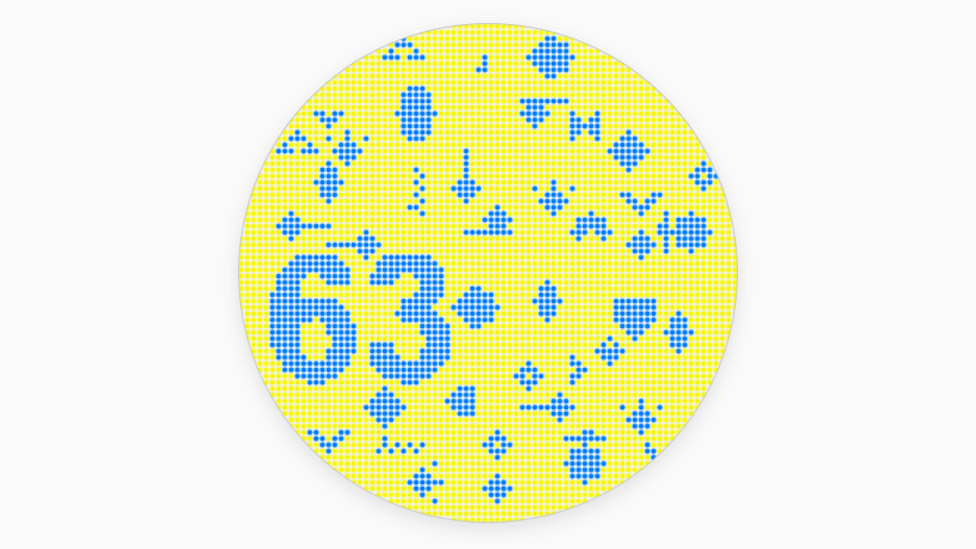
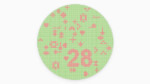
Yellow-blue color vision test plate with number 63 on it
Understanding tritan vision deficiencies
Short-wavelength-sensitive (S) cones mediate perception of blues and contribute to blue-yellow contrasts. When S-cones are absent the result is tritanopia; when they function atypically it is tritanomaly. Both reduce sensitivity along the blue-yellow axis but to different degrees.
Causes
- Congenital: rare variants in the S-cone opsin can produce lifelong tritan defects.
- Acquired: more common; linked to aging-related lens yellowing, cataract, macular disease, diabetic retinopathy, glaucoma, optic neuropathies, and some medications or toxins. Severity may fluctuate with the underlying condition.
What screening can and cannot do
An online tritan color blindness test or tritanopia test, like this one, can flag patterns consistent with a blue-yellow loss, but it cannot confirm diagnosis or separate retinal from optic causes.
Clinical evaluation may include standardized arrangement tests (e.g., Farnsworth D-15 or desaturated D-15), instrumented hue-discrimination tasks, and a full ocular exam.
Test mechanics and good practice
Screening plates work by reducing chromatic separation while holding luminance roughly constant. A blue yellow reverse color blind test inverts which region is “signal” versus “background”; similar performance in both directions reduces the chance that luminance cues or plate learning drove the result. Stable, neutral lighting and a calibrated display improve reliability.
Functional impact and management
Blue-yellow losses can impair map reading, medical imaging review, UI icon recognition, and safety-critical signalling in aviation or maritime contexts. Management focuses on the cause: treat ocular disease where present; consider display profiles with larger chromatic separations; use redundant cues (shape, text, motion); and, when helpful, selective tints for contrast enhancement. Persistent difficulty on a tritan color blindness test warrants assessment by an eye-care professional.
FAQ
- What is tritanopia? – It is a blue-yellow color vision deficiency caused by the absence of S-cones.
- What is tritanomaly? – A partial defect where S-cones function abnormally, reducing discrimination between blue and yellow.
- Is the blue and yellow color blind test diagnostic? – No, it is a screening tool only. Clinical tests are needed for diagnosis.
- How rare is blue-yellow deficiency? – Much rarer than red-green, affecting a very small percentage of the population.
- Can tritan defects be corrected? – No cure exists, but tinted lenses and accessibility tools may improve perception.
- Who should take a tritanopia color blindness test? – Anyone experiencing confusion between blue and yellow tones, or for educational interest.
- How accurate is an online tritan colour blind test? – It can highlight potential issues but is influenced by screen calibration, lighting, and environment.
Sources and references
- American Academy of Ophthalmology – Color Blindness
- Colour Blind Awareness
- NCBI – Inherited Color Vision Deficiency
What is your score in this test? Would you like to see any extra features in it? Let us know in the comments section!
CalcuLife.co



Leave A Comment