

This online tool estimates your contrast sensitivity function (CSF) — how faint a striped pattern (a sine-wave grating) you can detect at different sizes, or spatial frequencies, measured in cycles per degree – cpd. It uses an adaptive staircase to find your near-threshold level and reports thresholds and contrast sensitivity by frequency.
Contrast Sensitivity Test
Press Start Test. Choose the stripe direction: Vertical, Horizontal, or Diagonal. The test adapts difficulty and estimates your threshold at several spatial frequencies (cycles/degree).
Optional: quick PPI/distance check (for more precise CSF)
Tip: hold a standard bank/credit card to the screen and match widths.
Your thresholds and contrast sensitivity (1/threshold) will appear here after the test, with interpretation.


How to use it (quick)
- Set your screen at a comfortable brightness in normal room light.
- Sit about an arm’s length from the screen and click “Start Test.”
- For each trial, choose the stripe direction: Vertical, Horizontal, or Diagonal. If unsure, guess.
- When finished, read the Results section: per-frequency thresholds, contrast sensitivity values, a small CSF plot, quality flags (e.g., floor/ceiling/unstable), and a plain-English summary.
- Optional: expand “quick PPI/distance check” to improve geometric accuracy (used to hit exact cpd on your display).
What the results mean
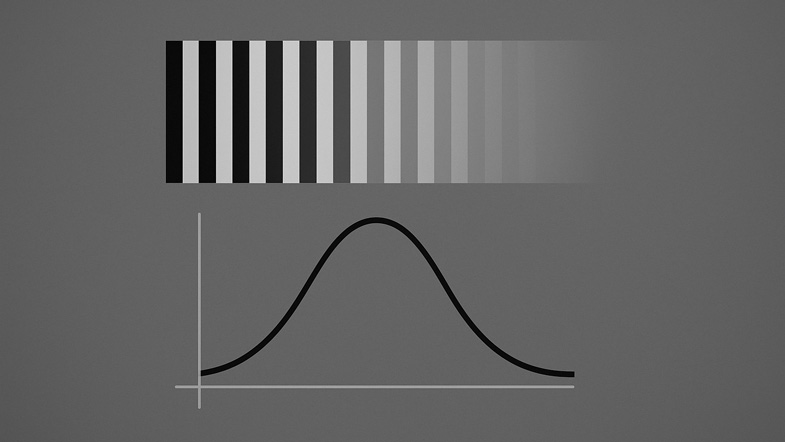
You’ll see a table and a curve. Each row shows spatial frequency (cpd), your threshold contrast (Michelson), and the resulting contrast sensitivity (CS = 1/threshold).
Higher CS means you can detect fainter stripes at that size. Most people show a band-pass shape that peaks in the mid-frequencies (~2–4 cpd) and drops at very low and very high cpd. The summary highlights your peak and compares low/mid/high bands relative to your own peak.
Why this test is meaningful (under the hood)
- Sine-wave gratings are the standard stimulus for CSF measurement; the clinical CSV-1000 uses 3, 6, 12, 18 cpd, which is offered here in “Clinical” mode. “Extended” mode adds very low and very high cpd for a fuller curve.
- Contrast is computed as Michelson contrast ( (Lmax − Lmin)/(Lmax + Lmin) ), the appropriate metric for periodic gratings.
- Thresholds are estimated with a 2-down/1-up staircase that converges near ~71% correct. After several reversals, step sizes tighten to probe very near threshold. Randomized phase and faint noise reduce display artifacts.
- We constrain rendering with a small visible contrast floor so the pattern never becomes literally uniform (prevents “it vanished” artifacts), and we flag any floor/ceiling hits in the results.
Tips for consistent measurements
- Keep the viewing distance steady; use the optional PPI/distance check if you want tighter cpd accuracy.
- Use normal room lighting; avoid glare and extreme brightness.
- If a row is flagged “unstable,” rerun—the threshold didn’t have enough reversals yet.
- Glasses/contacts: test with your usual correction for the distance you use.
Common questions
“What is cpd?” Cycles per degree is how many light-dark pairs fit into one degree of your visual angle. Higher cpd = finer stripes.
“Why not letters?” Letter charts mainly probe high spatial frequency at high contrast (acuity). Contrast sensitivity covers all sizes and low contrast too, which often explains real-world “I can see 20/20, but…” complaints.
“Are my numbers ‘normal’?” Populations vary with age and lighting; the classic CSF peaks in the mid-frequencies and is lower at the extremes. If you’re worried about your results or notice asymmetry/changes, consult an eye-care professional.
Limitations & good practice
- Consumer displays vary; precise calibration (luminance linearity, gamma) is not enforced here.
- Ambient light, fatigue, and attention affect thresholds. Repeatability improves with practice and consistent conditions.
- This tool complements, not replaces, professional testing (e.g., CSV-1000/2000, Pelli-Robson, laboratory CSF).
Sources & further reading
- CSV-1000 clinical contrast sensitivity test (frequencies 3, 6, 12, 18 cpd). VectorVision — CSV-1000
- Contrast sensitivity function (CSF) overview, typical band-pass shape. Wikipedia — Contrast (vision)
- Adaptive up-down staircase method; threshold convergence (~70.7%). Levitt, 1971 — Transformed up-down methods in psychoacoustics (JASA)
CalcuLife.com




Do you know how this test may be adapted for use on a large screen to test CS for far distance, i.e. 20 feet (6m)
Please email [email protected]