

Compute the volume of a right circular cylinder from radius and height with mixed units. The calculator supports radius and height in centimeters (cm), millimeters (mm), meters (m), inches (in), and feet (ft), and returns volume in any measurement unit you need.
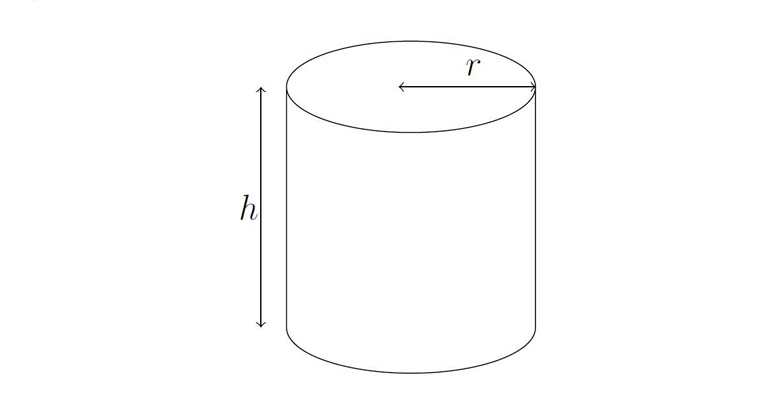
Radius is the distance from the edge of a circle to its center. Height is the distance from one circle to another.
Cylinder Volume Calculator
Enter radius and height, select units, and press Convert. Volume uses V = π × r² × h.
Radius
Height
Result
Output Unit


How to use
- Enter radius and height in the input fields above the calculator.
- Select the unit for radius and the unit for height (cm, mm, m, in, ft).
- Pick the output volume unit (m³, L, mL, cm³, in³, ft³, yd³, US gal, Imp gal).
- Click Convert. The result field shows the volume; the process line shows the formula and conversions used.
- Adjust Decimal Places to set the precision of the result and the process line.
- Use Copy Result to place the formatted value into your clipboard.
- Clear All resets inputs, units, and precision to defaults.
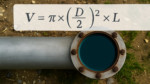
The formula for calculating the volume of the cylinder
Geometric volume of a right circular cylinder: V = π × r² × h, where r and h are the radius and height in the same length unit. In this calculator, r and h are converted to meters, V is computed in cubic meters (m³), then converted to the requested volume unit.
Source: Wolfram MathWorld — Cylinder.

Let your cylinder never crumple
Definitions and unit facts
Centimeter (cm, SI length)
1 cm = 0.01 m. Common for small dimensions. In this calculator, radius or height set in cm is converted to meters for the geometric formula.
Millimeter (mm, SI length)
1 mm = 0.001 m. Useful for fine measurements. The tool converts mm to meters before computing volume.
Meter (m, SI length)
Base SI unit of length. 1 m = 100 cm = 1000 mm. Using m for radius and height directly yields volume in m³ before any unit conversion.
Inch (in, Imperial/US length)
1 in = 25.4 mm exactly = 0.0254 m. The calculator converts inches to meters for the geometry step.
Foot (ft, Imperial/US length)
1 ft = 12 in = 0.3048 m exactly. Feet are converted to meters before computing volume.
Cubic meter (m³, SI volume)
1 m³ = 1000 L = 1,000,000 cm³. Primary geometric result from V = π·r²·h when r and h are in meters.
Liter (L, SI-derived volume)
1 L = 0.001 m³ = 1000 mL = 1000 cm³. The calculator multiplies m³ by 1000 to produce liters.
Milliliter (mL, SI-derived volume)
1 mL = 0.001 L = 1 cm³. The tool converts from m³ by 1 m³ = 1,000,000 mL.
Cubic centimeter (cm³, SI volume)
1 cm³ = 1 mL. From m³: 1 m³ = 1,000,000 cm³.
Cubic inch (in³, Imperial/US volume)
1 in³ = (0.0254 m)³ = 16.387064 cm³ ≈ 16.387064 mL. From m³: divide by 0.0254³.
Cubic foot (ft³, Imperial/US volume)
1 ft³ = (0.3048 m)³ = 0.028316846592 m³ ≈ 28.316846592 L. From m³: divide by 0.3048³.
Cubic yard (yd³, Imperial/US volume)
1 yd³ = (0.9144 m)³ = 0.764554857984 m³ ≈ 764.554857984 L. From m³: divide by 0.9144³.
US gallon (US gal, US customary volume)
1 US gal = 231 in³ exactly ≈ 3.785411784 L. From m³: multiply by 264.17205236.
Imperial gallon (Imp gal, UK volume)
1 Imp gal = 4.54609 L exactly. From m³: multiply by 219.9692483.
Conversion table (example values)
The table shows cylinder volume from selected radius and height pairs, reported in m³ and L.
| Radius (cm) | Height (cm) | Volume (m³) | Volume (L) |
|---|---|---|---|
| 2 | 10 | 0.000126 | 0.126 |
| 2 | 20 | 0.000251 | 0.251 |
| 3 | 10 | 0.000283 | 0.283 |
| 3 | 20 | 0.000565 | 0.565 |
| 4 | 10 | 0.000503 | 0.503 |
| 4 | 20 | 0.001005 | 1.005 |
| 5 | 10 | 0.000785 | 0.785 |
| 5 | 20 | 0.001571 | 1.571 |
| 6 | 10 | 0.001131 | 1.131 |
| 6 | 20 | 0.002262 | 2.262 |
| 7 | 10 | 0.001539 | 1.539 |
| 7 | 20 | 0.003079 | 3.079 |
| 8 | 10 | 0.002011 | 2.011 |
| 8 | 20 | 0.004023 | 4.023 |
| 9 | 10 | 0.002545 | 2.545 |
| 9 | 20 | 0.005091 | 5.091 |
| 10 | 10 | 0.003142 | 3.142 |
| 10 | 20 | 0.006283 | 6.283 |
| 12 | 15 | 0.006787 | 6.787 |
| 15 | 20 | 0.014137 | 14.137 |
Real-world cylindrical objects (exact models with published specs)
- 12 oz (355 mL) standard beverage can — Diameter 66 mm, height 122.22 mm; nominal fill 355 mL (0.355 L = 0.000355 m³).
- 16 oz (473 mL) “tallboy” can — Diameter 66 mm, height 157.23 mm; nominal fill 473 mL (0.473 L = 0.000473 m³).
- 330 mL standard can — Diameter 66 mm, height 115.2 mm; nominal fill 330 mL (0.330 L = 0.000330 m³).
- 250 mL slim can — Diameter 53 mm, height 133 mm; nominal fill 250 mL (0.250 L = 0.000250 m³).
- 330 mL “sleek” can — Diameter ≈ 2.28 in (≈ 57.9 mm), height ≈ 5.75 in (≈ 146 mm); nominal fill 330 mL (0.330 L = 0.000330 m³).
- #10 food can (105 oz) — Industry size “603 × 700” (⌀ 6 3/16 in × 7 in ≈ ⌀ 157 mm × 178 mm); nominal capacity 105 US fl oz (≈ 3.105 L = 0.003105 m³).
- 55-gallon steel drum — Typical interior radius ≈ 11.25 in (⌀ 22.5 in ≈ 572 mm); nominal capacity 55 US gal (≈ 208.197 L = 0.208197 m³).
- 400 mL aerosol can — Common spec ⌀ 65 mm × 159 mm; nominal fill 400 mL (0.400 L = 0.000400 m³).
- NHL hockey puck (solid cylinder) — Regulation ⌀ 3 in (76.2 mm), thickness 1 in (25.4 mm) → geometric volume ≈ 0.1158 L (0.0001158 m³).
- D-cell battery (solid cylinder) — Standard ⌀ 33.2 mm, length 61.5 mm → geometric volume ≈ 0.05324 L (0.00005324 m³).
What are you using this calculator for? Tell us your scenario and what features you’d like added. Drop a note in the comments.
© CalcuLife.com






Leave A Comment