

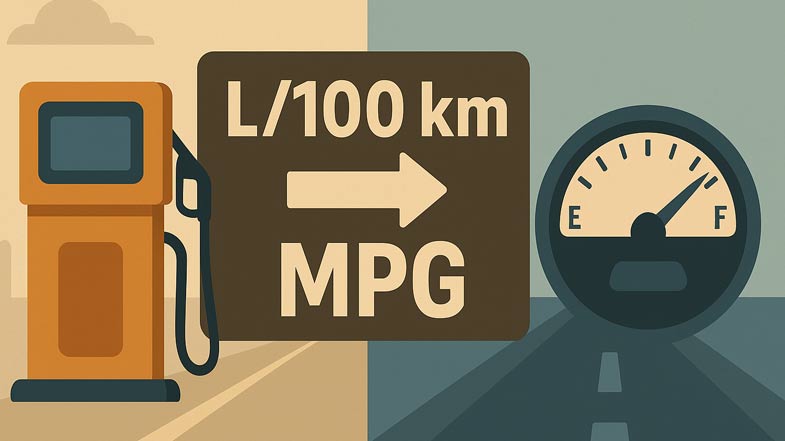
This online calculator converts fuel consumption expressed as liters per 100 kilometers (L/100 km) to miles per U.S. gallon (MPG, US). L/100 km is a metric fuel-consumption metric (lower = better). MPG (US) measures distance per unit of fuel (higher = better).
L/100 km to MPG Converter
Enter fuel consumption in liters per 100 kilometers (L/100 km) below and press Convert to get miles per gallon (MPG). Lower L/100 km means better fuel efficiency, higher MPG means better fuel efficiency. This tool converts between them.
Liters per 100 km (L/100 km)
Result in MPG (miles per gallon)


How to use the tool
- Enter the fuel consumption value in liters per 100 km (example: 6.5).
- Set the number of decimal places for the result if needed.
- Press Convert. The tool computes MPG (US) and shows the calculation step.
- Use Copy Result to copy the numeric MPG value to clipboard.
- Use Reset to clear inputs and return to default decimal precision.
- The tool validates input: value must be numeric and greater than zero.
Definitions of the units
Liters per 100 kilometers (L/100 km)
Abbreviation: L/100 km. System: SI-derived metric. Definition: volume of fuel (liters) consumed to travel 100 kilometers. Example relation for this converter: 1 L/100 km ≡ 235.214583 MPG (US) when inverted by the standard formula below. One liter is 1.0 L. Use-case: common in Europe, Canada, Australia and many other markets to report vehicle fuel consumption. Notes: Lower L/100 km means higher efficiency.
Miles per U.S. gallon (MPG, US)
Abbreviation: mpg or MPG (US to disambiguate from Imperial gallon). System: US customary (distance per fuel volume). Definition: number of statute miles a vehicle travels on one U.S. liquid gallon (1 US gallon = 3.785411784 L). Relation used here: MPG (US) = 235.214583 ÷ (L/100 km). Use-case: widely used in the United States and commonly shown on EPA labels.
Conversion formula and authoritative source
Formula (plain text): MPG (US) = 235.214583 ÷ (L/100 km)
Exact source: Wikipedia – Fuel economy in automobiles
Conversion table (L/100 km → MPG (US))
| L/100 km | MPG (US) |
|---|---|
| 1 | 235.21 |
| 2 | 117.61 |
| 3 | 78.40 |
| 4 | 58.80 |
| 5 | 47.04 |
| 6 | 39.20 |
| 7 | 33.60 |
| 8 | 29.40 |
| 9 | 26.13 |
| 10 | 23.52 |
| 12 | 19.60 |
| 14 | 16.80 |
| 16 | 14.70 |
| 18 | 13.07 |
| 20 | 11.76 |
| 25 | 9.41 |
| 30 | 7.84 |
| 35 | 6.72 |
| 40 | 5.88 |
| 50 | 4.70 |
Real-world examples (exact published combined ratings)
Notes: examples use manufacturer or official WLTP/EPA combined figures published by manufacturers or official brochures. These are the published combined consumption numbers for the specified model/trim at the time those documents were published; conditions and test procedures differ by region. Each example shows the exact source.
- 2021 Toyota Prius (combined rating listed as 4.4 L/100 km). Converted: 4.4 L/100 km → 53.46 MPG (US).
- 2021 Toyota Corolla Hatchback Hybrid (combined WLTP listed as 4.4 L/100 km). Converted: 4.4 L/100 km → 53.46 MPG (US).
- Volkswagen Golf 1.5 TSI (example combined WLTP figure: 5.5 L/100 km). Converted: 5.5 L/100 km → 42.76 MPG (US).
- 2021 Honda Civic (example combined WLTP reference 6.0 L/100 km for some trims). Converted: 6.0 L/100 km → 39.20 MPG (US).
- 2021 Ford Focus (example combined WLTP entry for certain trims ~5.1 L/100 km). Converted: 5.1 L/100 km → 46.12 MPG (US). Source: Ford technical brochure and specification sheets.
- Toyota Prius Prime (EPA combined example ~5.6 L/100 km equivalent; converted value shown for reference). Converted: 5.6 L/100 km → 42.00 MPG (US).
- Honda Clarity (published combined fuel consumption example 5.6 L/100 km for some powertrains). Converted: 5.6 L/100 km → 42.00 MPG (US).
- Volkswagen Golf Variant 1.5 TSI Active (combined WLTP example 5.5 L/100 km). Converted: 5.5 L/100 km → 42.76 MPG (US).
- Toyota Corolla Touring Sports (hybrid example combined 4.7 L/100 km). Converted: 4.7 L/100 km → 50.05 MPG (US).
- Volkswagen Golf (example combined WLTP 5.5 L/100 km for certain trims). Converted: 5.5 L/100 km → 42.76 MPG (US).
Notes on accuracy and variability
Official published figures come from test cycles (WLTP, EPA) that use standardized procedures. Real-world consumption can vary with driving style, load, terrain, maintenance and environmental conditions. Use published combined ratings only as a standard reference point.
Would you like to get any other online tools? Let us know in the comments!
CalcuLife.com









Leave A Comment