

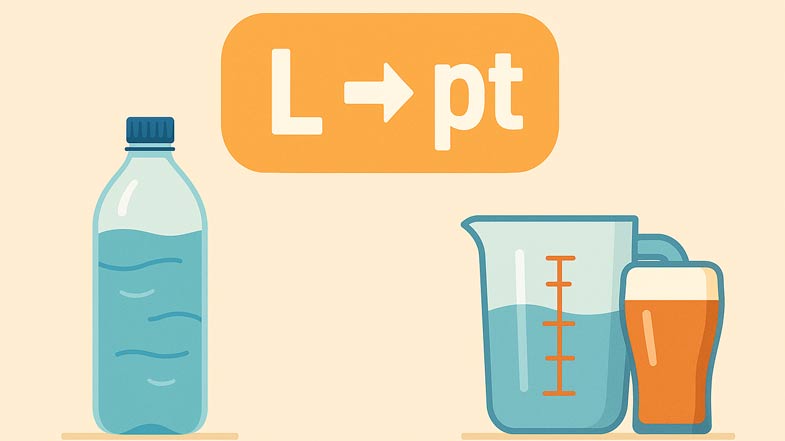
This online calculator converts volumes measured in liters (L) into U.S. liquid pints (pt, US). Liters are the metric unit commonly used worldwide. U.S. liquid pints are used in U.S. customary measurements for liquid volume. Both units and abbreviations shown here are the official/commonly used forms.
Liters (L) to US Pints (pt) Converter
Enter a value in liters in the field below and click Convert to get the equivalent volume in US pints
Liters (L)
Result in US Pints (pt)


How to use the tool
- Enter a numeric value in liters in the input field.
- Optional: set the number of decimal places for the result; default precision is suggested for clarity.
- Press Convert to compute the equivalent number of U.S. liquid pints.
- The calculation step and numeric result are displayed for verification.
- Use Copy Result to copy the numeric result to clipboard.
- Use Clear or Reset to empty fields and restore default precision.
- Validation: input must be numeric and non-negative; negative values are rejected with an explanation.
Definitions of the units
Liter (L)
Abbreviation: L. System: metric (SI-derived). Definition: one liter equals one cubic decimeter (1 L = 1 dm³ = 0.001 m³ = 1000 cm³). Relation in this converter: 1 liter = 2.1133764188652 U.S. liquid pints (exact to the constant used). Practical note: liter is the standard bottle and packaging measure in most countries.
U.S. liquid pint (pt, US)
Abbreviations: pt, US pt, or US pint when disambiguation is needed. System: United States customary (liquid volume). Definition: one U.S. liquid pint equals one-eighth of a U.S. liquid gallon. Exact relation: 1 U.S. liquid pint = 0.473176473 liters (derived from the U.S. liquid gallon definition). In this converter the reciprocal constant is used: 1 liter = 2.1133764188652 US pints. Use: beverage containers, cooking measures, and packaging in the United States.
Conversion formula and authoritative source
Formula: US pints = liters ÷ 0.473176473
or equivalently US pints = liters × 2.1133764188652
Authoritative source: NIST Handbook 44 Appendix C — General Tables of Units of Measurement
Conversion table (Liters → US pints)
| Liters (L) | US pints (pt) |
|---|---|
| 0.001 | 0.002113 |
| 0.010 | 0.021134 |
| 0.050 | 0.105669 |
| 0.100 | 0.211338 |
| 0.200 | 0.422675 |
| 0.250 | 0.528344 |
| 0.500 | 1.056688 |
| 0.750 | 1.585032 |
| 1.000 | 2.113376 |
| 1.500 | 3.170064 |
| 2.000 | 4.226753 |
| 2.500 | 5.283441 |
| 3.000 | 6.340129 |
| 4.000 | 8.453506 |
| 5.000 | 10.566882 |
| 7.500 | 15.850383 |
| 10.000 | 21.133764 |
| 15.000 | 31.700646 |
| 20.000 | 42.267528 |
| 50.000 | 105.668821 |
Real-world examples (exact standard measures)
Values below use exact standard package/definition volumes or exact unit definitions (no approximations of variable objects). Results shown to reasonable precision.
- US liquid pint glass (standard) = 1 US pt = 0.473176473 L.
- US measuring cup (1 cup = 8 US fl oz) = 0.2365882365 L = 0.5 US pt (exact).
- US liquid quart definition = 0.946352946 L = 2.0 US pt (exact).
- US liquid gallon (definition) = 3.785411784 L = 8.0 US pt (exact).
- Metric 1 liter bottle = 1.000 L = 2.113376419 US pt (exact per constant used).
- 2 L soda bottle (standard) = 2.000 L = 4.226752838 US pt.
- 500 mL water bottle (standard) = 0.500 L = 1.056688209 US pt.
- 750 mL wine bottle (standard) = 0.750 L = 1.585032314 US pt.
- 12 US fl oz soda can (12 fl oz = 0.75 US pt) = 0.354882355 L = 0.750000 US pt (12 fl oz is 3/4 of a pint).
- 1 US tablespoon (definition: 1 tbsp = 1/2 US fl oz) = 0.01478676478125 L = 0.031250 US pt (exact ratio: 0.5 fl oz ÷ 16 fl oz per pint = 1/32 pint).
Precision and accuracy note
The numeric constants are derived from the exact U.S. liquid gallon and liter relationships used in standards publications. Calculated results are exact within the chosen rounding precision; real-world packaging tolerances and labeling may round values for consumer purposes.
What are you using this tool for and would you like other specific unit converters made? Please let us know politely in the comments.
CalcuLife.com






Leave A Comment