

Online calculator for converting length from inches (inch; in, ″) to centimeters (centimetre; cm) using the legitimate standard: 1 in = 2.54 cm. Provides accurate results with adjustable rounding, copy-to-clipboard function, and quick link to the reverse cm → in tool. Useful for technical drawings, product specs, engineering data, and everyday measurements.
Inches (in) to Centimeters (cm) Converter
Enter a value in the field below and press the button
Inches (in)
Result in Centimeters (cm)


How to use
- Enter the length in inches in the input field.
- Press Convert to compute the value in centimeters.
- Set Decimal Places (0–10) to control rounding precision.
- Click Copy Result to copy the computed value.
- Use Swap to access the reverse cm → in calculator.
- Press Clear All to reset inputs, outputs, and the calculation line.
Units and definitions
Inch (in, ″) — A unit of length in the Imperial and US customary systems. Defined in 1959 by international agreement as exactly 1 in = 2.54 cm = 25.4 mm. Also equal to 1/12 of a foot and 1/36 of a yard. Common in hardware, construction, displays, and legacy engineering drawings. System: Imperial/US customary. In this calculator: 1 in = 2.54 cm (exact).
Centimeter (cm) — A metric unit of length in the International System of Units (SI), derived from the metre. 1 m = 100 cm, 1 cm = 10 mm = 0.01 m. Equivalent to 1 cm ≈ 0.393701 in. Common in science, medicine, consumer products, and everyday measurements. System: SI (metric). In this calculator: 1 cm = (1 ÷ 2.54) in (exact).
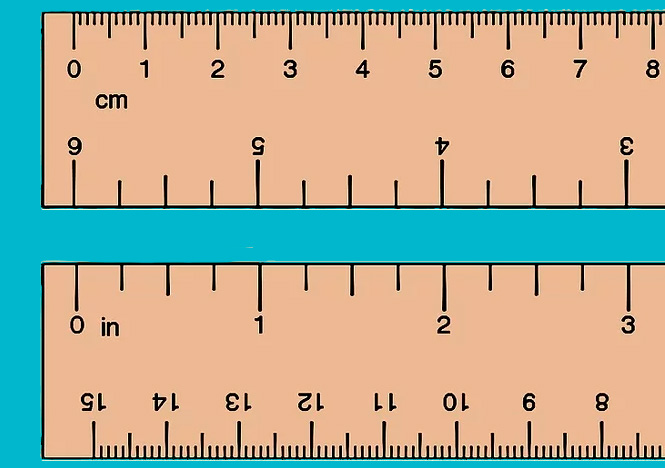
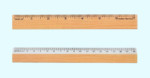
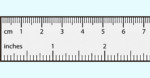
Visual comparison of an inch and a centimeter
Inches to Centimeters — what this online calculator does
Online calculator for converting length from inches (inch; in, ″) to centimeters (centimetre; cm) using the exact relation 1 in = 2.54 cm. Provides accurate results with adjustable rounding, copy-to-clipboard function, and quick link to the reverse cm → in tool. Useful for technical drawings, product specs, engineering data, and everyday measurements.
How to use
- Enter the length in inches in the input field.
- Press Convert to compute the value in centimeters.
- Set Decimal Places (0–10) to control rounding precision.
- Click Copy Result to copy the computed value.
- Use Swap to access the reverse cm → in calculator.
- Press Clear All to reset inputs, outputs, and the calculation line.
Units and definitions
Inch (in, ″) — A unit of length in the Imperial and US customary systems. Defined in 1959 by international agreement as exactly 1 in = 2.54 cm = 25.4 mm. Also equal to 1/12 of a foot and 1/36 of a yard. Common in hardware, construction, displays, and legacy engineering drawings. System: Imperial/US customary. In this calculator: 1 in = 2.54 cm (exact).
Centimeter (cm) — A metric unit of length in the International System of Units (SI), derived from the metre. 1 m = 100 cm, 1 cm = 10 mm = 0.01 m. Equivalent to 1 cm ≈ 0.393701 in. Common in science, medicine, consumer products, and everyday measurements. System: SI (metric). In this calculator: 1 cm = (1 ÷ 2.54) in (exact).
Conversion formula
centimeters (cm) = inches (in) × 2.54
inches (in) = centimeters (cm) ÷ 2.54
Source: NIST Handbook 44, Appendix C — General Tables of Units of Measurement
Conversion table (in → cm)
| in | cm |
| 1 | 2.54 |
| 5 | 12.7 |
| 10 | 25.4 |
| 25 | 63.5 |
| 50 | 127 |
| 100 | 254 |
| 250 | 635 |
| 500 | 1270 |
| 1,000 | 2540 |
| 2,000 | 5080 |
| 3,000 | 7620 |
| 5,000 | 12700 |
| 10,000 | 25400 |
| 15,000 | 38100 |
| 20,000 | 50800 |
Real-world, exact-size examples
- US Letter paper: 8.5 × 11 in = 21.59 × 27.94 cm
- US Legal paper: 8.5 × 14 in = 21.59 × 35.56 cm
- ISO A4 paper: 8.268 × 11.693 in = 21.0 × 29.7 cm
- Credit card (ISO/IEC 7810 ID-1): 3.370 × 2.126 in = 8.56 × 5.398 cm
- Compact disc (CD) diameter: 4.724 in = 12.0 cm
- US quarter (coin) diameter: 0.955 in = 2.426 cm
- AAA battery (IEC R03) length: 1.752 in = 4.45 cm
- 19-inch rack panel width: 19.00 in = 48.26 cm
- Rack unit (1U) height: 1.75 in = 4.445 cm
- Index card (3 × 5): 3.00 × 5.00 in = 7.62 × 12.70 cm
What’s your use case for this calculator, and what features would help you (e.g., fraction input, mixed units, batch conversion)? Share your scenario in the comments.
CalcuLife.com





Great explanation of inches to cm conversion. The examples make it very easy to understand, especially for beginners. Thanks for sharing this guide.
Can you explain how decimal values convertingin inches?
Hey! What do you mean? To convert decimal inches to centimeters, multiply by 2.54
Example: 5.5 * 2.54 = 13.97 cm.
The decimal part is just part of an inch, like 0.5 = half an inch.